Caspase 3 Human Caspase Cysteine Peptidase Enzymatic LeadHunter Assay - TW
OVERVIEW
DOCUMENTS/REFERENCES
Biological Information
Background Information:
Caspases are the executioners of programmed cell death (apoptosis), a normal process used physiologically to eliminate specific cells or cell types without damaging surrounding cells or causing an inflamatory response. All caspases belong to a family of proteases characterized by a cysteine residue in the active site and display specificity for Asp residues. Caspases are present in all cells as a procaspase, which becomes activated through proteolytic cleavage by other proteases including other caspases. Caspase-3 (CPP32, Yama, and apopain) is constitutively expressed in cells as a 32 kD procaspase. Activation of caspase 3 occurs by cleavage of the procaspase into 12 and 17 kD mature fragments by caspase 8, 6 and GranzymeB. Mice deficient in caspase 3 die within three weeks of birth due to failure of neuronal apoptosis. These mice display hyperplasia, duplicated brain structures and ectopic cell masses. However, the defects are restricted to the neural tissues, other organs are normal; indicating that caspase 3 has a non-redundant role in neural apoptosis. Caspase inhibitors are currently sought as therapeutics for such diseases as Alzheimer's, Parkinson's and cerebral/myocardial ischemia.
Family:
Protease
Sub Family:
Caspase
Class:
Cysteine Peptidase
Protein Name:
Caspase 3
Uniprot Number:
P42574
Gene Name:
CASP3
Gene ID:
836
Gene Aliases:
CPP32|CPP32B|Yama|apopain
Accession Number:
NM_004346
Organism:
Human
Construct Details:
Fragment, Recombinant
Assay Information
Assay Type:
Biochemical
Assay Sub Type:
Enzymatic
Functional Mode:
Antagonist
Detection Method:
Spectrofluorimetry
Measured Response:
Fluorescence
Testing Information
Procedure Summary:
Human recombinant caspase 3 expressed in E. coli is used. Test compound and/or vehicle is preincubated with 150 U/ml enzyme‡ in modified HEPES buffer pH 7.4 for 15 minutes at 37⁰C. The reaction is initiated by addition of 50 μM Ac-DEVD-AMC for another 60 minute incubation period. Determination of the amount of AMC formed is read spectrofluorimetrically at 360 nm/465 nm. Compounds are screened at 10 μM.
Substrate:
50 µM Ac-DEVD-AMC
Incubation:
60 min at 37°C
Control Inhibitor:
Ac-DEVD-CHO
Criteria For Significance:
≥ 50% of max stimulation or inhibition
Test Concentration / Dose:
Suggested concentration for initial testing is 10 uM
Test Sample Requirements:
Minimum for 1) Screen: 25 μl of 10 mM stock -OR- 1 mg (pre-weighed). 2) Dose Response: 60 μl of 10 mM stock -OR- 1 mg (pre-weighed).
Minimum Order Quantity:
2
Turnaround Time
Standard:
15 Business Days
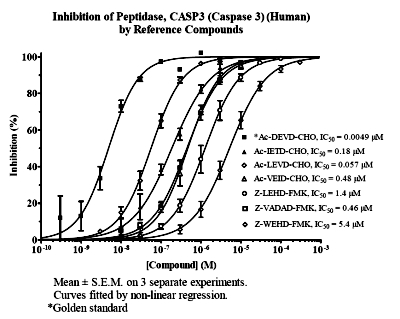
Reference Compound Data
Clinical Relevance
Therapeutic Area:
CNS/Addiction/Pain
Additional Information
Brand:
LeadHunter
Testing Location:
Taiwan - Taipei
RELATED SOLUTIONS
Metabolic Dysfunction-Associated Steatohepatitis (MASH) LeadHunter Panel - TW
Item: PP318
Caspase LeadHunter Panel - TW
Item: PP325
Questions? Contact Us
You can easily get in touch with a Eurofins Discovery Expert or get help from our Customer Service team. Reach out with questions, or to discuss your specific discovery challenges.
