UGT1A1 Human Glycosyltransferase Enzymatic LeadHunter Assay - TW
OVERVIEW
DOCUMENTS/REFERENCES
Biological Information
Background Information:
UDP-glucuronosyltransferases (UGT) represents a family of enzymes which catalyze the linkage of glucuronic acid with endobiotic (e.g. steroids and bilirubin) and exobiotic (e.g. drugs and carcinogens) chemical compounds. Glucuronidation is a major Phase II metabolic pathway for the inactivation and excretion of many of the pharmaceutical products currently in use. To date, at least 16 human UGT enzymes have been cloned and sequenced. Like the P450s, individual UGT's have unique, yet overlapping substrate specificities. UGT1A1 (UGT1A) has been reported as specific for estradiol and bilirubin glucuronidation.
Family:
Glycosyltransferase
Sub Family:
UDP Glucuronosyltransferase
Protein Name:
UGT1A1
Uniprot Number:
P22309
Gene Name:
UGT1A1
Gene ID:
54658
Gene Aliases:
UGT1A
Accession Number:
NM_000463
Organism:
Human
Construct Details:
Full Length, Recombinant
Assay Information
Assay Type:
Biochemical
Assay Sub Type:
Enzymatic
Functional Mode:
Antagonist
Detection Method:
Spectrofluorimetry
Measured Response:
Fluorescence
Testing Information
Procedure Summary:
Human recombinant UDP-glucuronosyltransferases μgT1A1 expressed in insect cells is used. Test compound and/or vehicle is preincubated with 10 μM scopoletin in modified Tris-HCl buffer pH 7.5 for 15 minutes at 25°C. The reaction is initiated by addition of 50 μg/ml enzyme for another 30 minute incubation period. Determination of the amount of scopoletin remained is read spectrofluorimetrically with excitation at 360 nm and emission at 460 nm. Compounds are screened at 10 μM.
Substrate:
10 µM Scopoletin
Incubation:
30 min at 25°C
Control Inhibitor:
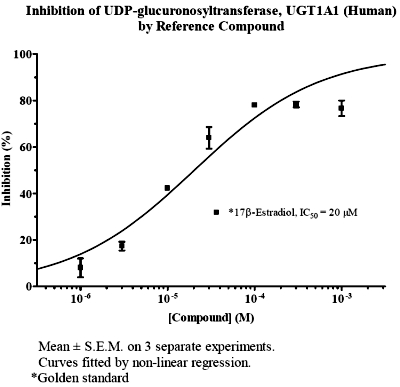
Estradiol
Criteria For Significance:
≥ 50% of max stimulation or inhibition
Test Concentration / Dose:
Suggested concentration for initial testing is 10 uM
Test Sample Requirements:
Minimum for 1) Screen: 25 μl of 10 mM stock -OR- 1 mg (pre-weighed). 2) Dose Response: 60 μl of 10 mM stock -OR- 1 mg (pre-weighed).
Minimum Order Quantity:
2
Turnaround Time
Standard:
15 Business Days
Reference Compound Data
Clinical Relevance
Adverse / Beneficial Action:
Inhibition of bilirubin glucuronidation may cause chronic hyperbilirubinemia that can lead to nervous system damage and death; inhibition may also interfere with glucoronidation and elimation of some drugs.
Additional Information
Brand:
LeadHunter
Testing Location:
Taiwan - Taipei
RELATED SOLUTIONS
AdverseReactionEnzymes SafetyScreen Panel - TW
Item: PP90
Questions? Contact Us
You can easily get in touch with a Eurofins Discovery Expert or get help from our Customer Service team. Reach out with questions, or to discuss your specific discovery challenges.
