PLC (Non-Selective) Bacteria Phospholipase C Enzymatic LeadHunter Assay - TW
OVERVIEW
DOCUMENTS/REFERENCES
Biological Information
Background Information:
The phospholipase C (PLC) class of enzymes catalyze hydrolysis of phosphodiester bonds in phosphotidyl cholines (PC) and phosphatidylinositols (PI) and play a role in the cascade of events involved in signal transduction. There are difficulties associated with the purification and isolation of mammalian PLCs while evidence suggests that the phosphotidylcholine-preferring PLC from Bacillus cereus (PLCBC) may be a useful model for mammalian PC-PLCs. Phosphodisterase degradation of PC has been shown to be activated in response to a number of agonists as well as oncogene products. In addition, a role for this pathway in the control of cellular functionality has been addressed.
Family:
Lipid Metabolism
Sub Family:
Glycerophospholipid Turnover
Class:
Phospholipase C
Protein Name:
Phospholipase C
Uniprot Number:
P0C216
Protein Aliases:
Lecithinase C, Lipophosphodiesterase I, PC-PLC
Accession Number:
NZ_QSVI01000005
Organism:
Bacteria
Construct Details:
Endogenous
Assay Information
Assay Type:
Biochemical
Assay Sub Type:
Enzymatic
Functional Mode:
Antagonist
Detection Method:
Spectrophotometry
Measured Response:
Absorbance
Testing Information
Procedure Summary:
Bacterial plospholipase PLC is used. Test compound and/or vehicle is preincubated with 20 mU/ml PLCǂ in 0.1 M 3,3-dimethylglutaric acid solution pH 7.3 for 15 minutes at 37°C. The reaction is initiated by addition of 0.4 mM 1,2-dihexanoyl-sn-glycero-3-phosphocholine for 5 minute incubation period and terminated by further addition of alkaline phosphatase and choline oxidase. Determination of the amount of phosphatidylcholine formed is read spectrophotometrically. Compounds are screened at 10 μM.
Substrate:
400 μM 1,2-Dihexanoyl sn-glycero-3-phosphocholine
Incubation:
5 min at 37°C
Control Inhibitor:
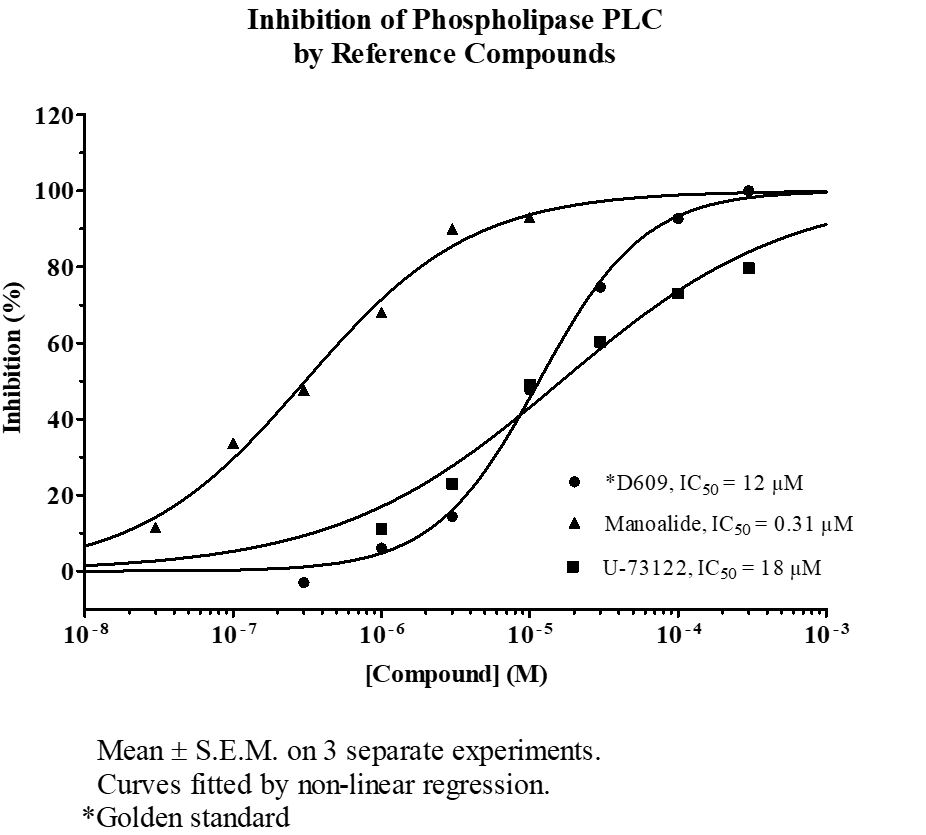
D609
Criteria For Significance:
≥ 50 of max stimulation or inhibition
Test Concentration / Dose:
Suggested concentration for initial testing is 10 uM
Minimum Order Quantity:
2
Turnaround Time
Standard:
15 Business Days
Reference Compound Data
Clinical Relevance
Therapeutic Area:
Inflammation/Allergy
Additional Information
Brand:
LeadHunter
Testing Location:
Taiwan - Taipei
Questions? Contact Us
You can easily get in touch with a Eurofins Discovery Expert or get help from our Customer Service team. Reach out with questions, or to discuss your specific discovery challenges.
