PKD2 Human Protein Ser/Thr Kinase Enzymatic Radiometric LeadHunter Assay [10 μM ATP] - TW
OVERVIEW
DOCUMENTS/REFERENCES
Biological Information
Background Information:
Two serine/threonine protein kinase D isoforms (PKD1 and PKD2), belonging to the polycystin family, are involved in protein-protein and protein-carbohydrate adhesion. The two isoforms are known to interact, and also thought to be ion channel regulators. PKD2 (PKD4, APKD2) bears closest homology with PKCµ and PKCν. Stimuli that activate PKD2 include phorbol esters, gastrin, and classical and novel PKC family members. Defects in PKD (inhibition of function) is responsible for human autosomal dominant polycystic kidney disease (ADPKD) that causes progressive renal failure and may also lead to liver cysts.
Family:
Kinase
Sub Family:
CAMK
Class:
Protein Ser/Thr
Protein Name:
PKD2
Uniprot Number:
Q9BZL6
Protein Aliases:
nPKC-D2
Gene Name:
PRKD2
Gene ID:
25865
Gene Aliases:
PKD2|HSPC187|DKFZP586E0820
Accession Number:
NM_016457
Organism:
Human
Construct Details:
Full Length, Recombinant
Assay Information
Assay Type:
Biochemical
Assay Sub Type:
Enzymatic
Functional Mode:
Antagonist
Detection Method:
Radiometry
Measured Response:
Scintillation
Testing Information
Procedure Summary:
Human recombinant protein kinase PKD2 expressed in insect Sf21 cells is used. Test compound and/or vehicle is preincubated with 100 mU/ml enzyme‡ in modified MOPS buffer pH 7.2 for 15 minutes at 37°C. The reaction is initiated by addition of 50 µM MAPKAPK, 10 µM ATP and 0.25 µCi [γ32P]ATP for another 30 minute incubation period and terminated by further addition of 3% H3PO4. An aliquot is removed and counted to determine the amount of [32P]MAPKAPK formed. Compounds are screened at 10 µM.
Substrate:
50 µM MAPKAPK
ATP Concentration:
10 uM
Incubation:
30 min at 37°C
Control Inhibitor:
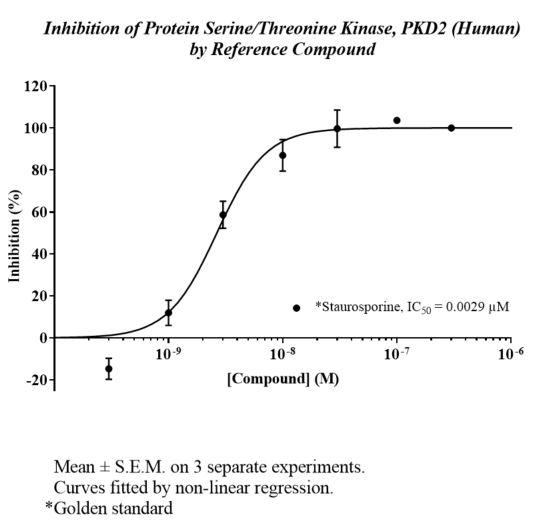
Staurosporine
Criteria For Significance:
≥ 50% of max stimulation or inhibition
Test Concentration / Dose:
Suggested concentration for initial testing is 10 uM
Test Sample Requirements:
Minimum for 1) Screen: 25 μl of 10 mM stock -OR- 1 mg (pre-weighed). 2) Dose Response: 60 μl of 10 mM stock -OR- 1 mg (pre-weighed).
Minimum Order Quantity:
2
Turnaround Time
Standard:
15 Business Days
Reference Compound Data
Clinical Relevance
Therapeutic Area:
Oncology/Immuno-Oncology
Adverse / Beneficial Action:
Defects in PKD (inhibition of function) is responsible for human autosomal dominant polycystic kidney disease (ADPKD) that causes progressive renal failure and may also lead to liver cysts.
Additional Information
Brand:
LeadHunter
Testing Location:
Taiwan - Taipei
RELATED SOLUTIONS
AdverseReactionEnzymes SafetyScreen Panel - TW
Item: PP90
Questions? Contact Us
You can easily get in touch with a Eurofins Discovery Expert or get help from our Customer Service team. Reach out with questions, or to discuss your specific discovery challenges.
