beta2 Human Adrenoceptor GPCR Cell Based Agonist & Antagonist cAMP LeadHunter Assay - TW
OVERVIEW
DOCUMENTS/REFERENCES
Biological Information
Background Information:
There are three known subtypes of b-adrenergic receptors, b1, b2, and b3, all of which are thought to couple primarily via Gsa to adenylyl cylase, leading to an increase in cAMP. The receptor subtypes differ primarily in their location: b1-adrenoceptors predominate in the heart, cerebral cortex, and the kidney. The major subtype in the lungs, cerebellum, uterus, skeletal muscle, and blood vessels is the b2-adrenoceptor. The b3-adrenoceptor has been detected in brain, stomach, and gall bladder but are expressed predominantly in white and brown adipose tissue (WAT and BAT, respectively). b2 adrenoceptors are mainly associated with causing relaxation of smooth muscle in a variety of tissues. Adrenergic b2 receptor agonism have been found useful in the treatment of bronchospasm but may facilitate cardiac arrest. Adrenergic b2 receptor antagonism may facilitate bronchospasm and impair exercise stress cardiovascular performance.
No. of Assays on Panel:
2
Assays on Panel:
Family
GPCR
Name
beta2 Human Adrenoceptor GPCR Cell Based Agonist cAMP LeadHunter Assay - TW
Item
302150-0
Protein
beta2
Organism
Human
Assay Sub Type
Cell Based
Family
GPCR
Name
beta2 Human Adrenoceptor GPCR Cell Based Antagonist cAMP LeadHunter Assay - TW
Item
302150-1
Protein
beta2
Organism
Human
Assay Sub Type
Cell Based
Family:
GPCR
Sub Family:
Adrenoceptor
Class:
Class A
Protein Name:
beta2
Uniprot Number:
P07550
Protein Aliases:
Beta-2 adrenoceptor
Gene Name:
ADRB2
Gene ID:
154
Gene Aliases:
ADRBR|BAR|B2AR
Accession Number:
NM_000024
Organism:
Human
Construct Details:
Full Length, Recombinant
Cell Type:
CHO-K1
Assay Information
Assay Type:
Functional
Assay Sub Type:
Cell Based
Functional Mode:
Agonist & Antagonist
Detection Method:
TR-FRET
Measured Response:
Fluorescence
Testing Information
Procedure Summary:
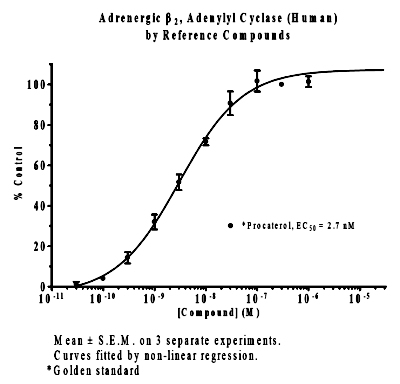
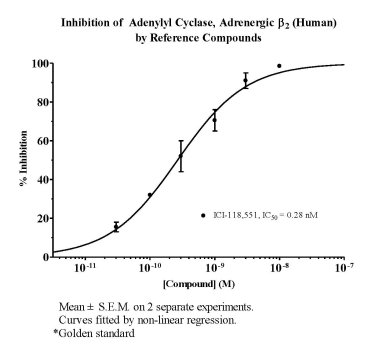
Human adrenergic b2 receptors expressed in CHO cells are used. Test compound and/or vehicle is incubated with the cells (2.5 x 10^5 cell/ml) in modified HBSS pH 7.4 buffer for 20 minutes at 37°C. The reaction is evaluated for cAMP levels by TR-FRET. Test compound-induced cAMP increase by 50 percent or more (≥50%) relative to the 0.3 µM procaterol control response indicates possible adrenergic b2 receptor agonist activity. Test compound-induced inhibition of the 0.01 µM procaterol-induced cAMP response by 50 percent or more (≥50%) indicates receptor antagonist activity. These same concentrations are concurrently applied to a separate group of treated cells and evaluated for possible compound-induced cytotoxicity only if significant inhibition of cAMP release is observed (Cat. #302170).
Incubation:
20 min at 37°C
Control Inhibitor:
ICI-118,551
Control Activator:
PROCATEROL
Criteria For Significance:
≥50% Increase in cAMP relative to procaterol response, ≥50% Inhibition of procaterol-induced cAMP increase
Test Concentration / Dose:
Compounds are screened at 10, 3, 1, 0.3, 0.1, 0.03, 0.01 and 0.003 μM
Test Sample Requirements:
75 μl of 10 mM stock or 1 mg (pre-weighed) powder (assuming FW ≦500 and purity 100%)
Minimum Order Quantity:
16
Turnaround Time
Standard:
20 Business Days
Reference Compound Data
Clinical Relevance
Therapeutic Area:
Pulmonology
Additional Information
Brand:
LeadHunter
Testing Location:
Taiwan - Taipei
RELATED SOLUTIONS
beta2 Human Adrenoceptor GPCR Cell Based Agonist cAMP LeadHunter Assay - TW
Item: 302150-0
beta2 Human Adrenoceptor GPCR Cell Based Antagonist cAMP LeadHunter Assay - TW
Item: 302150-1
beta2 Human Adrenoceptor GPCR Binding Antagonist Radioligand LeadHunter Assay - TW
Item: 204110
Questions? Contact Us
You can easily get in touch with a Eurofins Discovery Expert or get help from our Customer Service team. Reach out with questions, or to discuss your specific discovery challenges.
